
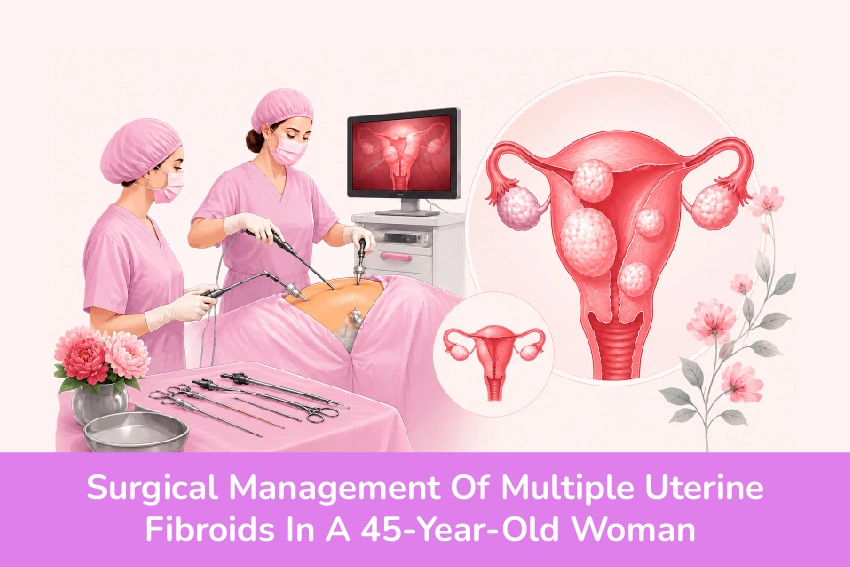
Surgical Management Of Multiple Uterine Fibroids In A 45-Year-Old Woman
Patient Profile
Age: 45 years
- One previous lower-segment caesarean section (LSCS) performed 17 years earlier
- Iron deficiency anaemia requiring iron infusion in 2014
- Gastric sleeve surgery performed in Spain in 2015
A] Clinical Presentation
A 45-year-old woman was referred for a specialist evaluation after her pelvic ultrasound revealed multiple uterine fibroids. Her medical history was significant for one lower-segment caesarean section (LSCS) that took place 17 years ago, iron deficiency anaemia that required an iron infusion treatment in 2014, and a gastric sleeve surgery that took place in Spain in 2015. Review of pelvic imaging here clearly demonstrated a bulky uterus containing at least four fibroids. The largest fibroid measured approximately 6 cm in diameter. Her anaemia deficiency was an important consideration, as it’s a commonly associated symptom with uterine fibroids. Depending on the size and location, fibroids can contribute to a range of symptoms. Her previous LSCS also helped us decide on a long-term fibroid treatment strategy.
Concerned about uterine fibroids? Let a specialist help you determine the most appropriate treatment approach.
B] Assessment And Treatment Planning
Following the initial consultation and review of the patient’s imaging results, a comprehensive assessment was undertaken. The presence of at least four fibroids within a bulky uterus, including a dominant fibroid measuring approximately 6 cm, was found. Special attention was given to the patient’s previous history of iron deficiency anaemia, lower segment caesarean section (LSCS) and gastric sleeve surgery. Our aim was to address the underlying fibroid disease while minimising the likelihood of future intervention. The potential benefits of ovarian conservation were discussed in quite detail. Following extensive consultation and shared decision-making, it was concluded that a laparoscopic hysterectomy for fibroids with ovarian conservation will be the most appropriate treatment approach.
C] Surgical Management
Following completion of the preoperative assessment and preparation, the patient underwent a laparoscopic hysterectomy with ovarian conservation. The procedure was performed using a minimally invasive approach, which allows the uterus to be removed through small abdominal incisions while still preserving the surrounding structures. The operation was completed successfully, with the uterus removed while conserving both her ovaries. The excised tissue was subsequently sent for histopathological examination to confirm the diagnosis and further evaluate the specimen. Histological assessment helped us get confirmation of the underlying pathology and exclude any unexpected abnormalities.
D] Recovery And Follow-Up
Her recovery was initially more challenging than anticipated due to a concurrent COVID-19 infection. And while this introduced additional complexity, close monitoring was undertaken to distinguish between the symptoms. Throughout her recovery, there were no significant indications of serious postoperative complications or other risks associated with laparoscopic hysterectomy. For precautionary measures, intravenous antibiotics were administered that would minimise the risk of postoperative infection. Given the patient’s recent surgery and concurrent illness, careful follow-up was undertaken to ensure that recovery was proceeding as expected. In conclusion, the patient had achieved a positive clinical outcome, with satisfactory healing and successful postoperative recovery.
E] What This Case Demonstrates
This case highlights the importance of individualised treatment planning when managing women with multiple uterine fibroids and a complex medical history. Factors such as previous surgery, a history of iron deficiency anaemia, uterine size, and the number of fibroids present can all influence the selection of your treatment strategy. Careful evaluation of the available fibroid treatment options helped ensure that the chosen approach addressed the underlying fibroid disease while preserving her ovarian function. It was through careful assessment, personalised treatment, appropriate management, and comprehensive follow-up care that a favourable clinical outcome was achieved.
As a private gynaecologist in London, Women’s Healthcare can help you with expert assessment and personalised care tailored to your individual needs. Contact us if you have been diagnosed with uterine fibroids or would like to discuss your treatment options with a specialist.
Looking for a Private Gynaecologist in London?

Mr Nilesh Agarwal
Mr Nilesh Agarwal (GMC: 6059455) is a highly esteemed consultant gynaecologist based in London, specialising in high-risk obstetrics, minimal access surgery, and fertility. With over 20 years of international experience, he provides comprehensive, patient-centred care for conditions including endometriosis, fibroids, and polycystic ovaries. Known for his holistic approach and clinical excellence, Mr Agarwal is dedicated to empowering women through tailored treatments. He currently practises at leading institutions, including the Clementine Churchill Hospital and the Hospital of St John & St Elizabeth.